Deaths of Boris Yvain and Geneviève
The King in YellowThe Deaths of Boris Yvain and Geneviève are the central catastrophe that ends the domestic, artistic, and scientific world surrounding Boris Yvain. They occur while Geneviève is drugged and unconscious or delirious, Boris Yvain is working on The Fates, and Jack Scott is watching him. Geneviève’s death by drowning is followed within moments by Boris Yvain’s suicide, leaving Jack Scott to conceal the bodies, erase the laboratory evidence, and bear an explanation that remains fundamentally incomplete.
Causes and Immediate Circumstances
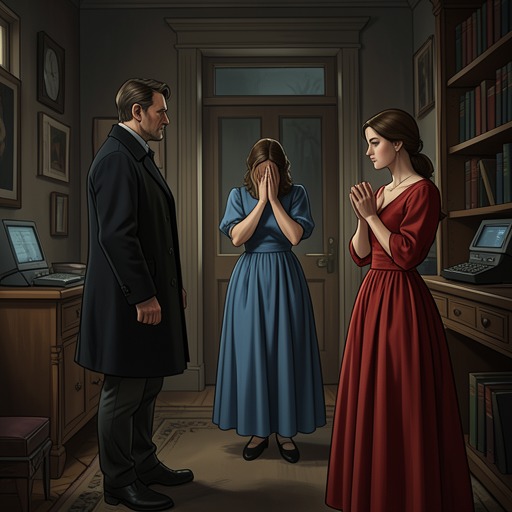
Geneviève had been severely disturbed and was sleeping under the influence of drugs. Boris Yvain told Jack Scott that she had been out of her mind, then returned to his work on The Fates rather than continuing the conversation. The scene therefore joins psychological crisis, artistic creation, and dangerous scientific knowledge: while Geneviève lies incapacitated, Boris Yvain continues shaping the sculptural group that has become inseparable from the tragedy.
Jack Scott notices that the third figure of The Fates, the figure looking straight ahead over the world, bears Boris Yvain’s face. It is not the face Jack Scott had known, but the face Boris Yvain possessed at that moment and retained until the end. This uncanny likeness becomes the one detail Jack Scott explicitly admits he cannot explain. The sculpture thus appears not merely to represent the catastrophe but to absorb Boris Yvain’s final condition before the deaths occur.
The Deaths
Boris Yvain and Jack Scott work and watch in silence until nearly midnight. A door opens and shuts sharply, followed by a rush in the adjoining room. Boris Yvain runs through the doorway, with Jack Scott immediately behind him, but they arrive too late: Geneviève is lying at the bottom of the pool with her hands crossed over her breast. The account establishes drowning as the immediate cause of her death, while leaving the precise circumstances of her entry into the pool unexplained.
Boris Yvain then shoots himself through the heart. The sequence is brutally compressed. Jack Scott first witnesses the apparently irreversible loss of Geneviève, and then Boris Yvain converts that loss into his own death. The event changes the value of the entire situation from desperate possibility to final absence: Geneviève cannot recover, Boris Yvain cannot answer for what happened, and Jack Scott becomes the sole living witness to a scene whose decisive causes remain obscure.
Jack Scott’s Concealment
After carrying Boris Yvain to his room, Jack Scott drains the pool and turns on all the water, washing the marble clean of every drop. He later finds Geneviève lying there as white as snow. The cleansing is both practical concealment and symbolic erasure, removing the visible trace of the deaths while preserving the fact that the house has become a site of inexplicable violence.
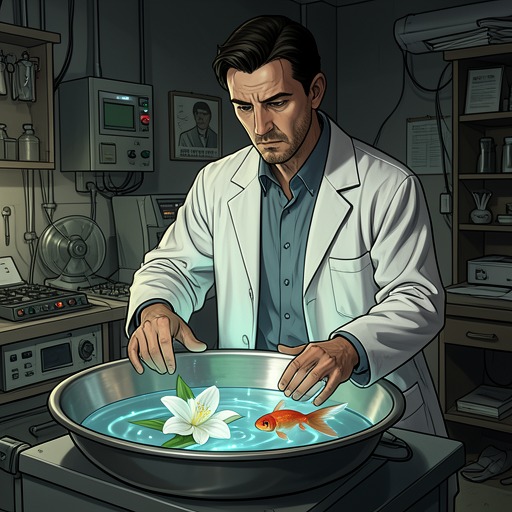
Jack Scott then enters the laboratory and empties the solution from the basin into the waste-pipe. He pours out the contents of every jar and bottle, burns the papers, notebooks, and letters in Boris Yvain’s cabinet, and smashes the empty bottles with a mallet from the studio. He makes six trips carrying the fragments to the cellar, where he throws them over the red-hot bed of the furnace. His stated purpose is to ensure that no vestige remains that could help anyone recover the formula Boris Yvain had discovered.
The destruction gives the deaths a second consequence: not only are the people lost, but the knowledge connected with Boris Yvain’s work is deliberately made unrecoverable. Jack Scott does not claim to understand the formula or the catastrophe. Instead, he acts under the pressure of uncertainty, choosing to eliminate the means of further investigation because the experiment’s possible consequences have become too dangerous to leave intact.
Public Explanation and Burial
Only after destroying the laboratory materials does Jack Scott call the doctor. Together they struggle to keep the matter from becoming public. The servants are paid and sent into the country, where old Rosier maintains the story that Boris Yvain and Geneviève have travelled abroad and will not return for years. The household’s disappearance is therefore converted into a fiction of distant travel, allowing the deaths to pass out of public knowledge.
Boris Yvain is buried in the small cemetery at Sèvres. The doctor supplies a certificate of heart disease and asks Jack Scott no questions. This official account conceals the suicide, while the servants’ story conceals both deaths. The contrast between the witnessed event and its public record is stark: the private truth consists of drowning, gunfire, destroyed evidence, and deliberate silence; the socially acceptable version consists of travel and natural illness.
Revelation, Aftermath, and Significance
The deaths are revealed to Alec only after he has begun to recover. Expecting to resume his former relations with Boris Yvain and Geneviève, he asks Jack Scott to bring Boris Yvain and sends his greeting to Geneviève. When Jack Scott finally makes him understand that both are dead, Alec falls into a rage so violent that it destroys his convalescent strength and causes a relapse. The deaths therefore continue beyond the Rue Sainte-Cécile house as a delayed psychological wound, disclosed only when Alec is strong enough to receive it and immediately forcing him back into illness.
Jack Scott’s narration is itself an act of painful witnessing. He tells Alec that no available clue allows either of them to explain what happened, admits that he wishes he could be spared the details, and nevertheless reopens the wound because Alec must learn the truth. The event is consequently framed not as a solved mystery but as an account whose most important fact is the persistence of the inexplicable.
A letter and the keys to Boris Yvain’s house arrive with the news. Boris Yvain’s will, dated a year earlier, leaves everything to Geneviève and provides that, if she dies childless, Alec is to control the house in the Rue Sainte-Cécile while Jack Scott manages the property at Ept. On their deaths, the property is to revert to Boris Yvain’s mother’s family in Russia, except for the sculptured marbles, which Boris Yvain leaves to Alec. The legal document extends the tragedy into inheritance: the dead continue to determine the living arrangements, property, and ownership of the surviving artwork.
The event’s lasting significance lies in this collision of death, art, knowledge, and concealment. Geneviève’s body disappears into a cleaned pool, Boris Yvain’s scientific record disappears into fire and furnace heat, and the public receives false explanations; yet The Fates preserves an image of Boris Yvain’s final face. The tragedy destroys the people and the formula while leaving behind an artwork, a will, a traumatized witness, and a story that can report the deaths without fully explaining them.